Studdly did not start as a Silicon Valley pitch deck. It started as a social project by high-school students in Warsaw, and it earned a Golden Wolf in the education category at Poland’s Zwolnieni z Teorii olympiad.
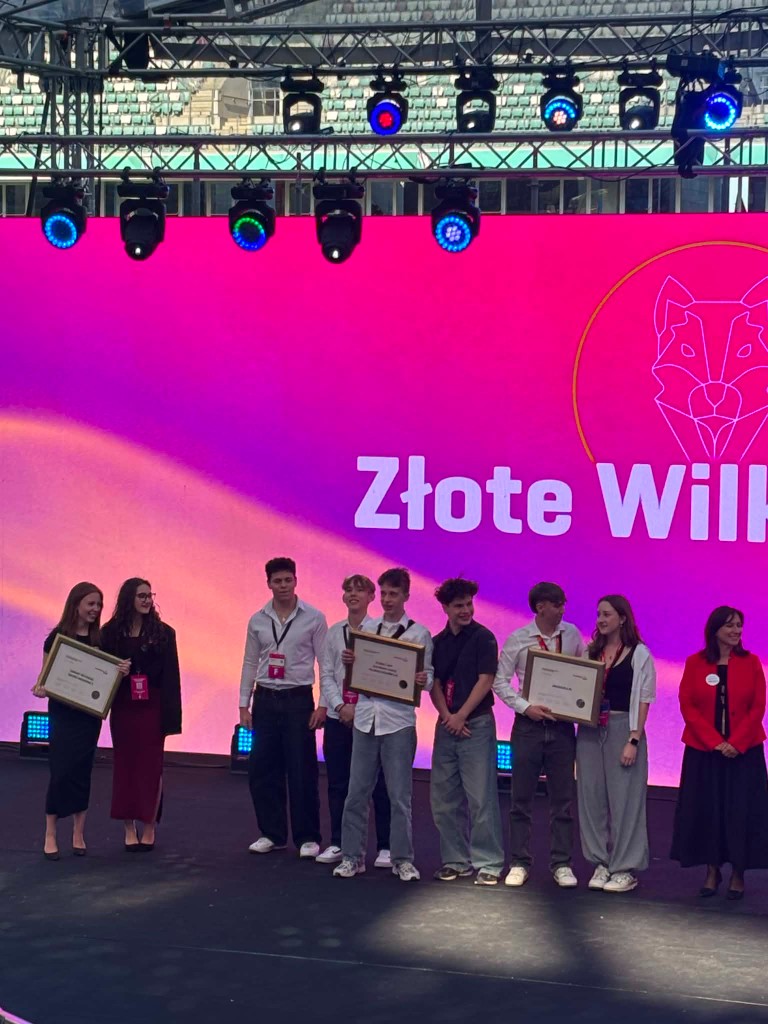
Zwolnieni z Teorii (often translated as “Exempt from Theory”) is Poland’s large practical olympiad for secondary-school social projects. Students design and run real initiatives, education, health, ecology, local community work, and more, instead of only writing theoretical papers. The Foundation Zwolnieni z Teorii has organised this model since 2013, pairing project skills with an online platform and a public Grand Finale.

The most prestigious award at the finale is the Złoty Wilk (the Golden Wolf). Coverage of the XII Grand Finale (28 May 2026, Legia Warsaw Municipal Stadium) reports that the edition drew more than 7,400 secondary students who delivered 1,534 social projects, with a record 300 initiatives nominated and 21 Golden Wolves awarded after an unusually strong year.
Among those winners: Studdly.app, built by students of CXXII Liceum Ogólnokształcące im. Ignacego Domeyki in Warsaw, which received a Golden Wolf in the education category. Contemporary reports describe the project as an AI-supported learning app meant to make studying more engaging, and note it was realised within a partner programme supported among others by ING Bank Śląski.
From a student’s chair, the problem is familiar in any country: the material is already in the textbook and in your notes, but turning that pile into something you can self-test takes hours you do not have before a quiz. Commercial “AI study” tools often want your files in the cloud, a subscription wall, or a workflow designed for adults managing corporate knowledge, not a teenager photographing page 214 on a bus.
The Studdly bet was narrower and more practical:
- Start from photos of real school materials (or gallery / PDF pages).
- Run OCR on the device so text extraction does not require uploading the photo album to a Studdly server.
- Use bring-your-own-key (BYOK) AI, the student pastes an API key for a provider they choose, to turn text into a learning path of mini subtopics and ABCD quizzes.
- Keep studying usable offline once the path exists.
That is the product shape described on the official site and in What is Studdly?, not a claim that AI replaces teachers, and not a promise of magical grade guarantees. It is a student-built loop: scan → read text locally → structure and quiz → revise.
Zwolnieni z Teorii scores projects on real delivery and impact, not only a demo day slide. For an education-tech idea, that pressure is useful: you have to ship something classmates can open, not only describe “disrupting learning.” Paula Bruszewska, president of the Foundation Zwolnieni z Teorii, said at the Golden Gala that the XII edition reached unprecedented quality, participant projects scored about 10% higher on average than the year before, which pushed the chapter to award 21 Golden Wolves. Studdly sits in that cohort as one education-category winner among many social initiatives nationwide.
For readers outside Poland: think of it as a national showcase where teenage teams are judged on whether they actually helped people through tutoring programmes, awareness campaigns, and accessibility projects, with technology projects held to the same “did it land in the real world?” standard.
Strip the origin story to the product: Studdly is an offline-first learning app. You scan textbook pages or notes (camera, gallery, or PDF). On-device OCR extracts the text on your phone. Then bring-your-own-key AI (your API key, your provider) builds a learning path of mini subtopics plus ABCD quizzes. Once that content is ready, reading and quizzes work offline. No claim that AI replaces teachers; no magical grade guarantee, a scan → local text → structure and quiz → revise loop.
Student-built origin is why that loop fits school better than many adult-designed “AI study” suites. Founders at CXXII LO in Warsaw (Zwolnieni z Teorii / Golden Wolf) lived the friction: material already on the page, no time to invent self-tests before a quiz, and little patience for cloud notebooks or corporate knowledge tools. They shipped the bottleneck they felt, turning real school pages into closed-book practice, not a social network, LMS, or settings-heavy spaced-repetition clone.
That same chair shows up in the privacy choices. School notes are sensitive; OCR stays on-device instead of uploading the photo album to a Studdly server. BYOK means the family or school policy chooses which AI vendor sees text when generation runs. Offline study afterward matches buses, basements, and exam weeks when signal dies. Those are design constraints from teenagers revising under pressure, not stickers bolted on later.
For parents and teachers abroad: the useful takeaway is not “only Polish olympiads create apps.” It is that people closest to chapter-to-quiz pain tend to prioritize quizzes over dashboards and thin clients over mystery homework clouds. See the app at studdly.app, same product shape this article’s Golden Wolf coverage described: an AI learning helper that makes studying more engaging by starting from the pages you already have.
Studdly is the app those Warsaw students shipped: scan pages, on-device OCR, BYOK AI learning paths and ABCD quizzes, offline revision. The Golden Wolf / Zwolnieni z Teorii story explains the motivation, the product is what you actually open before a test.
Student-built matters because the fit is school-shaped: privacy-aware OCR, simple flows, quizzes from your own book, not another generic chatbot wrapper. That is why the origin section belongs next to a clear product explanation.
Use the tool the story is about: studdly.app.
Winning a Golden Wolf is a milestone, not the product roadmap. The ongoing work is the same unglamorous loop: clearer OCR from real textbooks, useful subtopics, quizzes that match what was on the page, and a privacy model students can explain to a parent in one sentence. Downloads live on Google Play and the App Store via studdly.app.
If you are a student elsewhere reading this: the useful takeaway is not “only Polish olympiads create apps.” It is that the pain of turning a chapter into self-tests is universal, and the people closest to that pain sometimes ship the tool.
- Bezprecedensowa jakość projektów i 21 Złotych Wilków…, Strefa Edukacji (XII Grand Finale, Studdly.app / CXXII LO, Golden Wolf in education)
- Mazovia Golden Wolves roundup, Good One PR / Prowly (28 May 2026 finale; Studdly education award; ING partner programme note)
- Unparalleled quality of projects and 21 Golden Wolves, Architektura & Biznes (EN)
- Zwolnieni z Teorii (foundation / olympiad)
- What is Studdly?
See the app the Warsaw team built, scan a page and try the learning path.
Go to Studdly